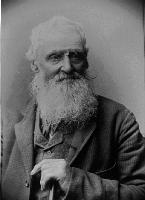
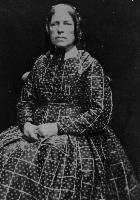
|
WILLIAM & SARAH MANWARING |
|
|
|
|
|
|
|
|
Very little is known of the couple prior to them emigrating to Australia in 1857. William Manwaring was born at Cranbrook on the 8th March 1808, the second son of William Manwaring and Jane Bradford. Sarah Manwaring, nee Judge, was born at Cranbrook on the 13th March 1807, the second daughter of Thomas Judge and Sarah Biggs. William and Sarah were married by Banns on 23rd February 1829 at St Dunstans Church, Cranbrook by Reverend I. Mofsop. The witnesses to the wedding were Richard Parrott and John Waters. The Judge household was a household worthwhile and apparently were well to do people. Sarah lived with her parents on their estate where William was working as one of four Groomsmen. Sarah was disowned by her parents when she married William, who they apparently thought was beneath her class standing. Over the next twenty one years William and Sarah had twelve children, all of which were born at Cranbrook and christened in St Dunstans Parish Church. Julie Elizabeth b. 1830 George b. 1831Thomas William b. 1833 Mary Ann b. 1834 Ellen b. 1837 Caroline b. 1838 William is listed in the 1841 Cranbrook Census as being an agricultural labourer and living on The Hill at Cranbrook and again in the 1851 Cranbrook Census as living at Golford Green, near Cranbrook, and working as an agricultural labourer so it is assumed he was a working man around this area all his life until he emigrated. It is said that the Manwaring family grew hops in Kent before emigrating to Australia. Times were hard for the working people of England in the 1850's, so William and his family decided to start a new life in a new land and emigrated to Australia on board the Anna Maria arriving in Australia on 25th June 1857. All of their children emigrated with them in 1857 except Julie Elizabeth who married James Skinner in 1849 at Cranbrook, and Mary Ann who died in 1839 at five years of age. William was 49 years old and Sarah 50 years old when they emigrated to Australia. This must have been a very hard decision for them to make at this time of their lives. Nothing is known of the whereabouts of William and Sarah for the two years after arriving in Australia. Stories have been told that they tried unsuccessfully to grow hops in the Sydney area and also that they travelled to the Appin area near Wollongong also to try growing hops in that area. We do know that they went to Bungendore around 1859. William bought two blocks of land in Bungendore township, one on the 12th April 1859 (Allotment 15 of Section 23) for the sum of seven pounds five shillings and the other a few months later on the 5th August 1859 (Allotment 8 of Section 23).William and Sarah and their family resided there, and while farming, being the only occupation they knew, leased land at Halfway Creek and with the help of their sons, George, Jesse, Edmund and Alfred, worked it until the early 1870's. On 16th December 1874 William applied to bring Allotment No. 8 under the Real Property Act and requested that the Certificate of Title (Vol. 121 Fol. 4) be issued to George Smith, Carpenter,of Bungendore. It is not known why he transferred this allotment to George Smith. He sold Allotment 15 to Snr Constable Bernard McKeon, of Bungendore, on the 12th June 1874 for the sum of nine pounds. The opportunity of purchasing their own land drew them away from Bungendore to the Cootamundra - Gundagai area of NSW. They moved to this area, known as the Kyron District, around 1874. In 1873 William and Sarah selected land and purchased it with the proceeds of the sales of the Bungendore Town Allotments. They bought Lots 54, 55 and 57 comprising 181 acres in total and by 1884 held 832 acres of land. They called their property "Rosehill". When they first arrived at Kyron, life must have been very hard. A bush shanty would have been built to house the family. The land would have to been cleared and the land worked to support the family. The first Rosehill home was built by William with the help of all his family. The home was Pise with a dirt or possibly a cowdung floor and was surrounded by a Hawthorn Hedge, part of which survives today. The large hedge was always cut once a year to keep it in check, trees were planted along the banks of the nearby creek and the garden of the home tended by Sarah in the fashion of an English Garden. This home became the meeting place for all the family with family gatherings and dances frequently being held there in the large living room. In 1886 William and Sarah gave the Department of Education as small portion of land very near their home for the purpose of establishing a school so their grandchildren and children from neighbouring families could have a decent education. I was told that William was known as "Bushy Bill" to the people of the Kyron area. William and Sarah worked this land and lived there for the rest of their lives. They saw their children acquire land, work hard, and forge a good living for their grandchildren and great grandchildren. Sarah died at Rosehill on the 20th December 1890 at the ripe old age of 83. She was certified by Dr Anderson as dying of cold and old age after a five day illness. She was buried two days later at Jugiong Cemetary. William lived for another 11 years without Sarah and died on 31st March 1902, age 94, at Rosehill. William's death was much more tragic. He unfortunately took his own life. An inquest was held into his death on 1st April 1902 at Rosehill. The Coroner, W. H. Mathews verdict being that the cause of death was - " inflammation of the lungs supervening upon an injury to the throat inflicted by himself while temporarily insane."William was buried with Sarah at Jugiong on 2nd April 1902. |
|
|
|
|